



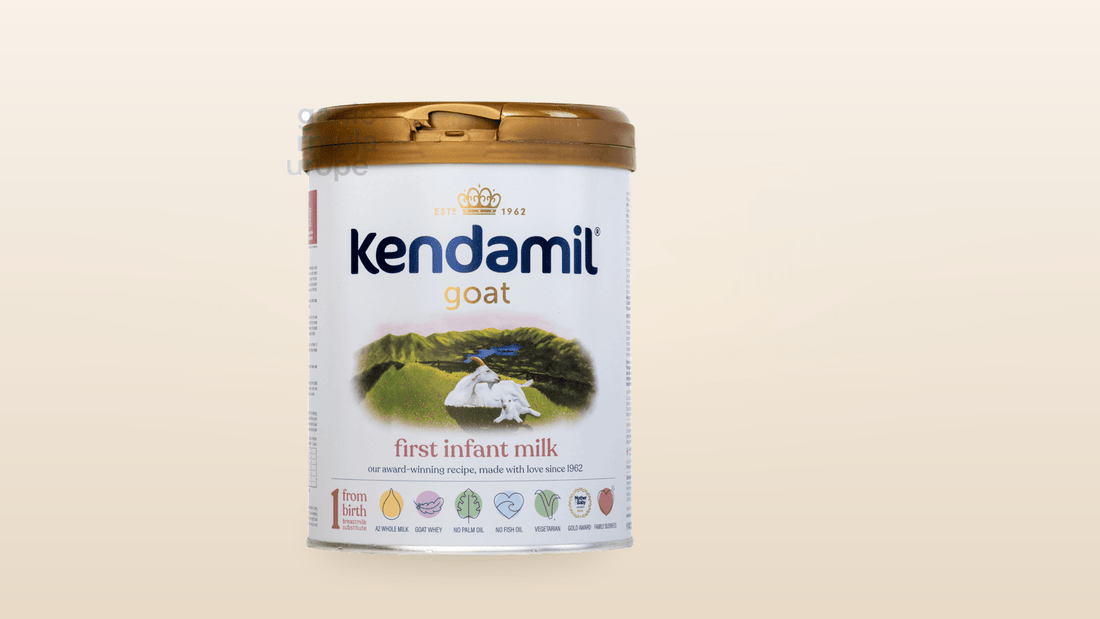
Kendamil Goat Formula Explained
Table of contents
Organic Formula Europe Team
Organic Formula Europe Team is the editorial team behind our Knowledge blog. We are a family business based in Germany that supplies European infant formula to families across the United States. Our articles are built on primary sources from the FDA, AAP, CDC, NIH, ESPGHAN and NHS, and are reviewed by a physician.
Overview
- Kendamil Goat is built on whole goat milk, with lactose as the main carbohydrate and GOS prebiotics. No palm oil and no maltodextrin are listed in any of the three stages.
- The goat range is not organic. Only the cow milk based Kendamil Organic line carries Soil Association certification, so there is no such product as Kendamil organic goat formula.
- Goat milk formula is not hypoallergenic. The NHS states that it is not suitable for babies with cow's milk allergy, because the proteins are very similar.
- Stage 1 covers birth to 6 months, Stage 2 covers 6 to 12 months, and Stage 3 is a growing up milk from 12 months.
Kendamil goat formula turns up on almost every shortlist of European formulas, usually for one reason: it starts with whole goat milk instead of skimmed milk with fat blended back in. It is also one of the harder products in the category to research, because the Kendamil name covers three different lines and the goat range exists in a European version and a separate American version that are not the same recipe.
This guide works through what is actually inside a can of Kendamil Goat, how the three stages differ, who the formula suits and who it does not, and what is worth checking before ordering a European can. The cans themselves sit on the Kendamil Goat Milk Formula collection page if it helps to look at them while reading.
What Is Kendamil Goat Formula?
Kendamil is a British brand produced in Kendal, Cumbria. The factory there has been making milk powder since 1962, and the Kendamil brand itself launched in 2016 under the McMahon family, who still own and run the business. The goat range is the part of that lineup that swaps cow's milk for whole goat milk.
Three features run through every stage of the range:
- The base is whole goat milk, not skimmed goat milk with vegetable fat added back in.
- There is no palm oil in the fat blend, which is unusual in this category. The palm oil question is one of the main reasons parents look at Kendamil in the first place.
- DHA comes from marine microalgae rather than fish oil, which keeps the formula vegetarian friendly.
One detail causes more confusion than anything else in this range. Cans sold on the European market and cans sold by Kendamil USA are not the same product. The European cans are made to EU infant formula rules and are labeled Product of the EU. The American cans were reformulated for the US market and went through a separate regulatory route. Both are called Kendamil Goat. Their ingredient lists do not line up, so a comparison only makes sense once you know which can you are holding.
What Is Inside a Can of Kendamil Goat?
The ingredient list is short by the standards of the category, and the things missing from it matter as much as the things on it. Here is the picture for the European cans, which are the ones shipped from Europe to US families.
| Component | Kendamil Goat, European cans |
|---|---|
| Milk base | Whole goat milk |
| Main carbohydrate | Lactose from goat milk |
| Prebiotics | GOS |
| Maltodextrin | Not listed in any stage |
| Vegetable oils | Sunflower, coconut, rapeseed |
| Palm oil | None |
| DHA source | Algae, Schizochytrium sp. |
| ARA source | Mortierella alpina oil |
| Can size | 800 g, scoop included |
Lactose, Not Corn Syrup or Maltodextrin
Lactose from goat milk supplies the carbohydrate in all three stages, and no maltodextrin appears in the recipes. That is the same carbohydrate profile human milk uses, and it is the main thing separating European formulas from many of the corn syrup based options on American shelves. A fuller comparison across the brand sits in the article on Kendamil formula ingredients.
Where the Fat Comes From
Because the base is whole goat milk, a meaningful share of the fat is milk fat rather than added vegetable oil. The remaining fat blend is sunflower, coconut and rapeseed oil. DHA, the long chain omega 3 that EU rules require in infant formula, is supplied by algae oil, and ARA comes from Mortierella alpina oil. No fish oil is used in the goat range.
Is Kendamil Goat Formula Organic?
No. This is worth saying flatly, because thousands of searches every month pair the words Kendamil, organic and goat, and no such can exists.
Kendamil runs three lines. Kendamil Organic is cow milk based and carries Soil Association certification, the UK's leading organic body. Kendamil Classic is cow milk based and not certified organic. Kendamil Goat is goat milk based and also not certified organic. Buying the goat range means choosing whole goat milk and a palm oil free fat blend, not an organic certificate.
If organic certification is the higher priority, the certified goat options come from other European brands rather than from Kendamil. Those cans sit alongside each other on the goat milk formula collection page, and the broader background is covered in the complete guide to goat milk formula.
Which Kendamil Goat Stage Does Your Baby Need?
The three stages follow the standard European pattern, and the age on the can is a starting point rather than a deadline.
| Stage | Age range | What it is for |
|---|---|---|
| Stage 1 | Birth to 6 months | First infant milk. For a baby who is not breastfed, this is the only milk needed during that window. |
| Stage 2 | 6 to 12 months | Follow on milk, adjusted for the weaning period. It sits alongside solid foods rather than replacing them. |
| Stage 3 | From 12 months | Growing up milk for toddlers who already eat a varied diet. |
Two points are easy to miss. Nothing forces a move up at exactly six months: Stage 1 is nutritionally complete for the whole first year, and plenty of families simply stay on it. And the American Academy of Pediatrics recommends iron fortified formula for every infant who is not breastfed, or only partly breastfed, from birth to one year, which all three stages are built to meet.² Stage by stage logic across the rest of the brand is covered in the guide to Kendamil stages 1, 2 and 3.
What Is the Difference Between Kendamil and Kendamil Goat?
This is the question Google surfaces most often alongside the brand, and the answer is mostly about the milk.
| Line | Milk base | Certified organic | Palm oil |
|---|---|---|---|
| Kendamil Goat | Whole goat milk | No | No |
| Kendamil Organic | Whole cow milk, Soil Association certified | Yes | No |
| Kendamil Classic | Whole cow milk | No | No |
All three share the whole milk base, the absence of palm oil and the algae sourced DHA. The goat line differs in the protein it delivers and in the certification it does not carry. Families who move between the lines usually do so for one of those two reasons, and the full lineup is on the Kendamil Formula collection page.
Is Kendamil Goat Formula Easier on Sensitive Tummies?
This is where marketing and evidence drift apart, so it is worth separating them.
Goat milk is naturally higher in A2 beta casein than standard cow's milk, and its curd behaves differently during digestion. That is a real compositional difference, and it is the reason many families try goat formula after a run of unsettled feeds.
What the research shows is narrower than the marketing. A 2023 systematic review and meta analysis pooled four randomised controlled trials covering 670 infants and found growth on goat milk formula matched growth on cow milk formula, with similar stool frequency and similar rates of adverse events.⁵ In other words, goat formula is a safe and well tolerated option. It is not an established treatment for digestive trouble.
The American Academy of Pediatrics puts it in similar terms: some parents believe goat based formula is tolerated better, with fewer upset stomachs, but that benefit is not certain.² If a baby is spitting up constantly, crying inconsolably or reacting to feeds, that is a conversation for a pediatrician rather than a reason to switch cans on your own.
Who Should Not Use Kendamil Goat Formula
One group should not use it at all. Goat milk formula is not hypoallergenic, and the NHS is unambiguous about this: goat's milk formulas are not suitable for infants with cow's milk allergy, because the proteins they contain are very similar.¹ The American Academy of Pediatrics says the same thing, that infants with cow's milk allergy should not use products made with goat's milk.²
A diagnosed cow's milk protein allergy calls for a medically appropriate formula chosen with a pediatrician, usually an extensively hydrolysed or amino acid based product. Kendamil Goat is not a substitute for one, and neither is any other goat formula on the market.
Breastfeeding remains the recommended standard for infant feeding wherever it is possible, and formula is an option alongside it rather than an argument against it. Families who combine the two do so routinely.
How Does Kendamil Goat Compare With HiPP and Holle?
Three European brands supply most of the goat formula reaching American families, and they solve the same problem differently.
- Kendamil Goat. Whole goat milk, no palm oil, DHA from algae. Not certified organic.
- HiPP Dutch Goat. Certified organic and manufactured in Germany. Its vegetable oil blend does contain organic palm oil, and its DHA comes from fish oil.
- Holle Organic Goat. Certified organic and based on whole goat milk powder.
The palm oil difference is the one most parents weigh, because it is often the reason they looked at Kendamil to begin with. The trade off runs the other way on certification, where HiPP and Holle carry organic status that Kendamil Goat does not. Side by side detail on all three sits in the goat milk formula guide.
Is Kendamil Goat Formula FDA Approved?
The European cans are not reviewed or approved by the FDA. That is the honest answer, and it applies to every European formula shipped to the United States, not just this one.
European formula is regulated under EU infant formula law, which sets its own compositional limits, requires DHA in every infant formula and governs labeling and contaminant thresholds. Those rules are strict, but they are not the FDA's rules. The FDA notes that formulas imported outside its review process are available online and from third party distributors, and that there is no scientific evidence showing they are better for babies than formula lawfully marketed in the United States.³
Separately, Kendamil does sell a US version of its goat formula that went through the American regulatory route. It is a different recipe from the European can. The wider background on why European formula sits outside FDA review is set out in the article on why HiPP formula is not FDA approved, and the reasoning applies equally to Kendamil.
How Do You Prepare and Store Kendamil Goat Formula?
Follow the instructions printed on the can first, since scoop size and water volume differ between brands. Beyond that, the CDC guidance on powdered formula applies to Kendamil Goat exactly as it does to any other powder.⁴
- Powdered formula is not sterile. For babies under 2 months, babies born before 37 weeks, and babies with a weakened immune system, the CDC advises boiling the water and letting it cool for about 5 minutes, to roughly 158°F, before mixing.⁴
- Use prepared formula within 2 hours, and within 1 hour once a feed has started.⁴
- Formula that is not used within 2 hours goes straight into the refrigerator and should be used within 24 hours.⁴
- Throw away whatever is left in the bottle after a feed.⁴
Two European quirks are worth knowing. Best before dates on EU cans print in day, month, year order, so 05/11/2027 means the fifth of November. And the scoop belongs to its own can, so it is best not to swap scoops between brands or stages. General preparation steps are walked through in the guide on preparing European formula at every stage.
Where Can You Buy Kendamil Goat Formula?
Two supply chains carry the same brand name, and they behave independently. The American version is sold through Kendamil USA and mainstream US retailers, and its availability has been uneven. The European version travels from EU distributors to specialist importers, and it is not affected by what happens to American retail stock.
That distinction explains most of the confusion around this product. A can listed as sold out on a US retail site says nothing about the European line. The three European stages are listed on the Kendamil Goat Milk Formula collection page, and the background on the US shortage, including what to use while waiting, is covered in the article on Kendamil Goat availability and alternatives.
Takeaway
Kendamil Goat is a straightforward product once the labels stop getting in the way. Whole goat milk as the base, lactose as the carbohydrate, GOS prebiotics, no palm oil and no maltodextrin, with DHA from algae rather than fish. It is not organic, it is not hypoallergenic, and the European cans are not FDA reviewed, all three of which are worth knowing before ordering rather than after.¹ For a baby with no diagnosed allergy whose parents want a whole milk European formula without palm oil, it is a sound choice, and the evidence says growth on goat formula tracks growth on cow formula closely.⁵ For a baby with a diagnosed cow's milk protein allergy, it is the wrong product, and a pediatrician should choose the right one.
Citations
- National Health Service (NHS). Types of formula milk. https://www.nhs.uk/conditions/baby/breastfeeding-and-bottle-feeding/bottle-feeding/types-of-formula/
- American Academy of Pediatrics. Choosing a Baby Formula, HealthyChildren.org. https://www.healthychildren.org/English/ages-stages/baby/formula-feeding/Pages/Choosing-an-Infant-Formula.aspx
- U.S. Food and Drug Administration. Resources for Parents and Caregivers on Imported Infant Formula. https://www.fda.gov/news-events/infant-formula-information-and-ongoing-fda-efforts-increase-supply/resources-parents-and-caregivers-imported-infant-formula
- Centers for Disease Control and Prevention. Infant Formula Preparation and Storage. https://www.cdc.gov/infant-toddler-nutrition/formula-feeding/preparation-and-storage.html
- Jankiewicz M, van Lee L, Biesheuvel M, et al., Nutrients 2023. The Effect of Goat-Milk-Based Infant Formulas on Growth and Safety Parameters: A Systematic Review and Meta-Analysis. https://pubmed.ncbi.nlm.nih.gov/37432055/
FAQs
Is Kendamil goat formula hypoallergenic?
No. Goat milk proteins are structurally very similar to cow's milk proteins, so goat formula is not suitable for a baby with a diagnosed cow's milk protein allergy. The NHS and the American Academy of Pediatrics both say so directly. A baby with a confirmed allergy needs an extensively hydrolysed or amino acid based formula chosen with a pediatrician.
Does Kendamil goat formula contain iron?
Yes. Iron is mandatory in EU infant and follow on formula, and all three Kendamil Goat stages are formulated to meet those levels. The American Academy of Pediatrics recommends iron fortified formula for every infant who is not breastfed, or only partly breastfed, through the first year.
Is Kendamil Goat the same in the US and in Europe?
No. Kendamil USA sells a version made for the American market that went through a separate regulatory route, and its recipe differs from the European can. Comparing ingredient lists only works once you know which market the can was produced for.
Can you switch from Kendamil Organic to Kendamil Goat?
Many families do, usually moving gradually over several days by replacing one feed at a time. Both lines use whole milk and avoid palm oil, so the change is mainly in the protein. Some babies show looser or firmer stools for a few days while adjusting. If a switch is being considered because of suspected allergy or reflux, talk to a pediatrician before making it.
Why is Kendamil goat formula so hard to find in stores?
Shortages have affected the American retail supply of Kendamil Goat rather than the European line, which runs through separate distributors. That is why a can can be sold out at a US retailer while the European stages remain listed with specialist importers.