



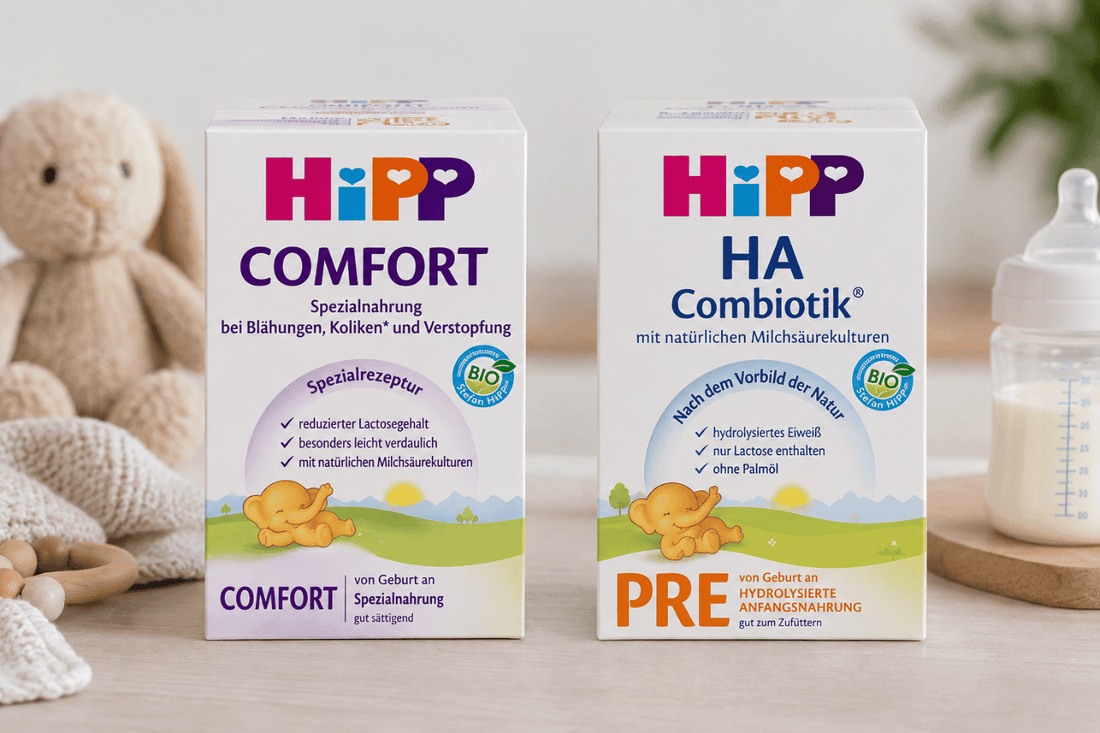
HiPP Comfort vs. HiPP HA Formula: What’s the Difference?
Table of contents

Ashlen Wilder
Ashlen Wilder is a freelance writer with over seven years of experience covering food, nutrition, business, and consumer products. Her articles on infant nutrition draw from reputable medical and government sources, with an emphasis on evidence-based information to help parents make informed decisions.
Overview
- HiPP Comfort is a specialty formula designed for babies experiencing gas, lactose-related colic, and constipation.
- HiPP HA is marketed by HiPP for babies with sensitive immune systems
- Both specialized formulas use hydrolyzed milk protein, and neither is appropriate for babies with true milk allergies
Choosing a baby formula can already feel complicated, and the number of specialty options doesn’t make it any easier. When exploring the HiPP formula range, parents might notice two options called HiPP Comfort and HiPP HA. Both contain hydrolyzed milk protein and are formulated with sensitive babies in mind, but they are designed for different needs.
The biggest difference between HiPP Comfort and HiPP HA is their intended purpose. HiPP Comfort is a specialty formula developed for babies experiencing digestive concerns, including gas, lactose-related colic, and constipation. HiPP HA, on the other hand, is a hydrolyzed formula designed by HiPP for babies with more subtle sensitivities.
Neither formula should be confused with an extensively hydrolyzed hypoallergenic formula prescribed for a diagnosed cow’s milk protein allergy. Here's when you should consider HiPP HA vs. HiPP Comfort.
What Is HiPP Comfort Formula?
HiPP Comfort formula is a specialty formula made for babies experiencing gas, lactose-related colic, and constipation. The formula uses several modifications intended to support easier digestion, including:
- Reduced lactose levels
- Milk protein that is hydrolyzed into smaller protein components
- Galactooligosaccharides (GOS), which are natural lactic acid cultures and added as a prebiotic
Because it contains reduced lactose, HiPP Comfort isn't the same thing as a lactose-free formula. Lactose intolerance is uncommon in infants, so digestive symptoms should always be discussed with a healthcare professional rather than diagnosed at home.
What Is HiPP HA Formula?
HiPP HA is a hydrolyzed baby formula from the German HiPP range. HA refers to hypoallergenic, and this formula differs from HiPP's regular formula line because:
1. Milk protein has been broken down through hydrolysis
2. Unlike HiPP Comfort, it contains lactose as its only carbohydrate
3. Galactooligosaccharides (GOS), which are natural lactic acid cultures and added as a prebiotic
HiPP describes its current HA Combiotik formula as being designed for babies with sensitive immune systems, with the formula improving the baby's microbiota.
However, the word “hypoallergenic” can be confusing. HiPP HA should not be treated as equivalent to the extensively hydrolyzed hypoallergenic formula used to manage a diagnosed cow’s milk protein allergy. Partially hydrolyzed formulas, including HA and comfort formulas, are not considered a suitable treatment for cow’s milk allergy.

HiPP Comfort vs. HiPP HA: What Are the Main Differences?
Although HiPP HA and HiPP Comfort both use hydrolyzed milk protein, the formulas have different purposes and compositions.
| Feature | HiPP Comfort | HiPP HA |
|---|---|---|
| Primary purpose | Digestive concerns such as gas, lactose-related colic, and constipation | Sensitive immune systems |
| Protein | Hydrolyzed milk protein | Hydrolyzed milk protein |
| Lactose | Reduced lactose | HiPP HA PRE contains lactose as its only carbohydrate |
| GOS prebiotic | Yes | Yes |
| Lactic acid cultures | Yes | Yes |
| From birth | Yes | HiPP HA PRE/HA 1 are designed for use from birth |
| CMPA treatment | No | No |
| Specialty formula | Yes | HA formula |
Parents should consider why a specialty formula is being used in the first place, and make this decision with their child's pediatrician.
HiPP Comfort and HiPP HA: How Does the Protein Compare?
Both HiPP Comfort and HiPP HA use hydrolyzed milk protein. Hydrolysis breaks proteins into smaller components rather than leaving the intact milk proteins found in many standard formula products.
This is also why you may see terms such as “hydrolyzed protein,” “partially hydrolyzed,” and “extensively hydrolyzed” while comparing formula for babies. These terms are not interchangeable. An extensively hydrolyzed formula breaks milk protein down more extensively and may be recommended for babies with cow’s milk protein allergy under medical supervision.
Parents should not assume that any formula using hydrolyzed protein is automatically a hypoallergenic formula appropriate for treating an allergy.
What’s the Difference in Lactose?
Lactose is one of the clearest differences when comparing HiPP Comfort vs. HiPP HA.
HiPP Comfort has a reduced lactose content because it is specifically formulated for digestive concerns that can include lactose-related colic. However, reduced lactose does not mean lactose-free.
HiPP HA PRE, on the other hand, uses lactose as its only carbohydrate. This makes its carbohydrate profile more similar to a standard PRE formula, since PRE formulas generally use lactose as their carbohydrate source.
The right formula shouldn't be selected based on lactose alone. If you suspect your baby has difficulty digesting lactose, talk to your pediatrician, as true lactose intolerance is uncommon in babies.
Are there different stages for HiPP HA and HiPP Comfort?
For HiPP Comfort, there is only one formula stage, but it is suitable to feed your baby this from birth. For HiPP HA, there are multiple formula stages, which range from PRE to stage 2. Parents may start with HiPP HA PRE or stage 1 from birth, and switch to stage 2 at 6 months. This switch is not, however, required, and babies can continue drinking stage 1 until they begin their transition to solid foods.
| Formula | Stage | Age |
|---|---|---|
| HiPP HA PRE | PRE | From birth |
| HiPP HA 1 | Stage 1 | From birth |
| HiPP HA 2 | Stage 2 | From 6 months |
| HiPP Comfort | One stage | From birth |
HiPP Comfort and HiPP HA for various symptoms
HiPP Comfort may be more suitable for digestive symptoms such as colic, constipation, gas, or bloating, while HiPP HA is generally intended for babies who may benefit from a gentler, partially hydrolyzed formula but do not have a diagnosed cow’s milk protein allergy. Neither HiPP Comfort nor HiPP HA should be used to treat a diagnosed or suspected cow’s milk protein allergy. A pediatrician may instead advise an extensively hydrolyzed or amino acid formula.
Colic and Constipation
When comparing HiPP Comfort vs. HiPP HA for digestive symptoms, HiPP Comfort is the product specifically formulated for digestive concerns.
HiPP Comfort is intended for gas, lactose-related colic, and constipation. Its reduced lactose content, hydrolyzed protein, GOS prebiotic, and specialized fat composition distinguish it from standard HiPP formula.
HiPP HA is not specifically formulated as a colic or constipation formula. Although its hydrolyzed protein may make it appealing to parents looking for a gentler formula, its primary intended purpose differs from HiPP Comfort. Persistent colic, constipation, or other digestive symptoms can have multiple causes, so discuss them with your pediatrician before changing formula.
Reflux
Neither HiPP Comfort nor HiPP HA is HiPP's dedicated anti-reflux formula. HiPP has a separate HiPP Anti-Reflux specialty formula, also known as HiPP AR, specifically formulated for babies with increased spit-up and reflux. Anti-reflux formulas are generally thickened to help feeds remain in the stomach.
If reflux is your baby's primary concern, comparing HiPP Comfort vs. HiPP HA may therefore be less useful than discussing HiPP AR with your pediatrician. Frequent or severe reflux should also be evaluated by a healthcare professional.
HiPP Comfort vs. Standard HiPP Formula
A standard HiPP formula is designed to provide complete nutrition for babies within the age range specified on the package. HiPP Comfort, by contrast, is a specialty formula with several compositional changes intended for babies with particular digestive concerns.
Compared with standard formula, HiPP Comfort has reduced lactose and hydrolyzed protein. These modifications are why HiPP recommends using the formula after consultation with a pediatrician rather than simply choosing it as an everyday alternative to standard HiPP.
For a baby who comfortably tolerates standard formula and has no indication for a specialty formula, there may be no reason to move to Comfort.

How Do You Choose the Right HiPP Formula for Your Baby?
The right HiPP formula depends on your baby's age, nutritional requirements, symptoms, and medical needs.
- A standard HiPP formula may be appropriate for a baby without special feeding concerns.
- HiPP Comfort may be considered when digestive issues such as gas, lactose-related colic, or constipation are the primary concern. HiPP HA is formulated for sensitive immune systems and uses hydrolyzed milk protein.
- For frequent reflux, HiPP Anti-Reflux may be a more relevant specialty formula to discuss with your pediatrician.
- If a milk protein allergy is suspected or diagnosed, neither HiPP HA nor HiPP Comfort should be used as a substitute for an appropriate extensively hydrolyzed or amino acid formula recommended by a healthcare professional.
Ultimately, choosing between HiPP Comfort and HiPP HA isn't about deciding which formula is “better.” It's about identifying which formula is appropriate for your baby's individual needs. View the full HiPP formula stage comparison here.
Takeaway
HiPP is a highly regarded European baby formula brand offering a wide range of organic baby formulas. While most babies will be able to consume the brand's regular formula line, babies who struggle to digest milk protein or have sensitive immune systems may do better with a specialized formula. HiPP Comfort is designed for babies experiencing gas, lactose-related colic, and constipation, while HiPP HA is recommended by the brand for babies with sensitive immune systems.
Both use hydrolyzed milk protein and GOS prebiotic components, but one key difference is that HiPP HA uses lactose as its only carbohydrate, while HiPP Comfort uses reduced lactose. Neither is a suitable option for babies with a true cow's milk allergy. Always consult your pediatrician before using a specialty formula or changing formula because of ongoing digestive or allergy symptoms.
What is the main difference between HiPP Comfort and HiPP HA?
The main difference between HiPP Comfort and HiPP HA is what each formula is designed for. HiPP Comfort is a specialty formula for babies with certain digestive concerns, including gas, lactose-related colic, and constipation. HiPP HA contains hydrolyzed milk protein and is designed for babies with sensitive immune systems.
Is HiPP Comfort or HiPP HA better for a milk protein allergy?
Neither HiPP Comfort nor HiPP HA should be used to treat a diagnosed cow’s milk protein allergy. Although both contain hydrolyzed protein, they are not the same as an extensively hydrolyzed hypoallergenic formula typically recommended for CMPA. If you suspect an allergy, speak with your pediatrician about the right formula for your baby.
Can I switch from HiPP HA to HiPP Comfort?
A switch from HiPP HA to HiPP Comfort may be appropriate in some circumstances, but the formulas are intended for different needs. Because HiPP Comfort is a specialty formula, HiPP recommends using it under medical supervision. Talk to your pediatrician before switching, particularly if your baby has ongoing digestive or allergy symptoms.
Does HiPP Comfort have less lactose than HiPP HA?
Yes. HiPP Comfort is made with reduced lactose as part of its formulation for certain digestive concerns. HiPP HA PRE, in comparison, contains lactose as its only carbohydrate. Neither formula is lactose-free.
Which HiPP formula is best for reflux?
HiPP Comfort and HiPP HA are not specifically formulated for reflux. HiPP Anti-Reflux, also called HiPP AR, is HiPP’s specialty formula designed for babies with increased spit-up and reflux. Speak with your pediatrician if your baby experiences frequent or severe reflux to determine which formula is most appropriate.
Citations
1. HiPP. HA COMBIOTIC®. HiPP Healthcare Professional website. https://hcp.hipp.com/products/hipp-milk-formulae/ha-combiotic/
2. HiPP. HiPP Comfort Special Formula. HiPP Healthcare Professional website. https://hcp.hipp.com/products/hipp-special-formula/hipp-comfort-special-formula/
3. Australasian Society of Clinical Immunology and Allergy. Milk substitutes in cow’s milk allergy. ASCIA. https://www.allergy.org.au/hp/papers/guide-for-milk-substitutes-cows-milk-allergy