



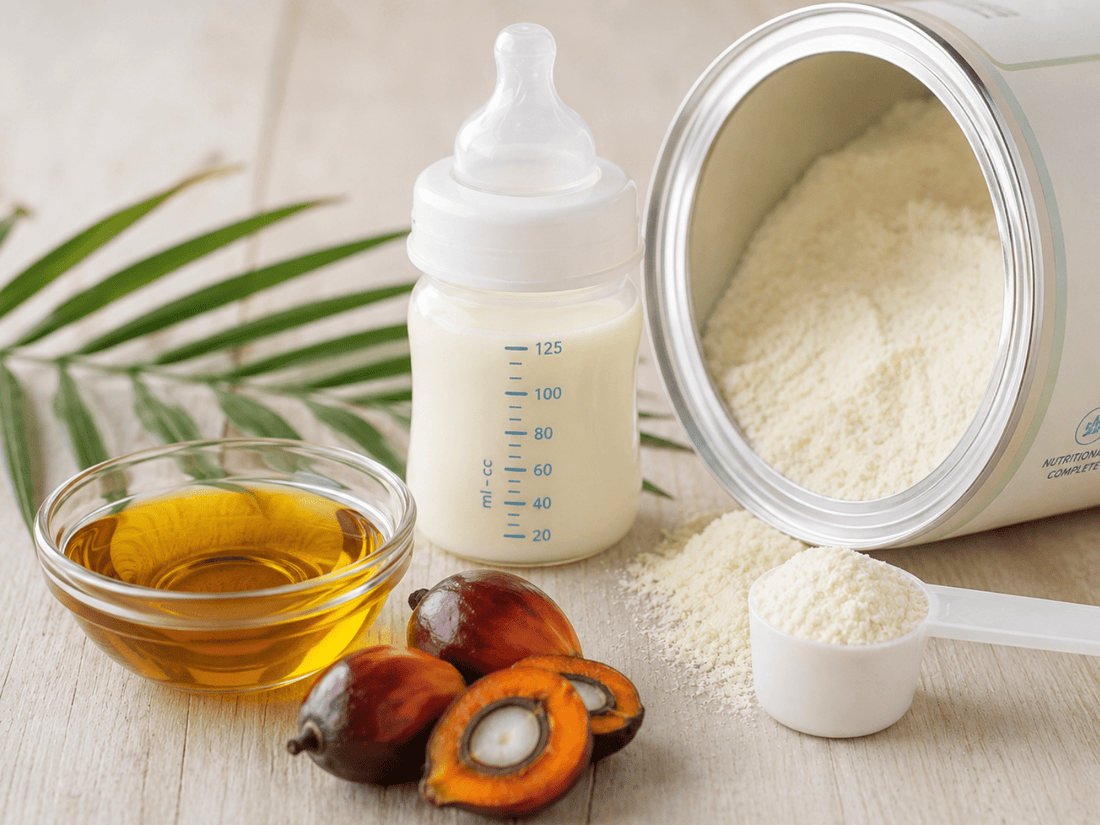
Palm Oil in Baby Formula
Table of contents

Ashlen Wilder
Ashlen Wilder is a freelance writer with over seven years of experience covering food, nutrition, business, and consumer products. Her articles on infant nutrition draw from reputable medical and government sources, with an emphasis on evidence-based information to help parents make informed decisions.
Overview
Palm oil is added to many infant formulas because its fatty acid profile resembles that found in human breast milk.
Some studies suggest palm oil may cause slightly harder stools in some infants compared to formulas using no palm oil at all.
Regulatory bodies including EFSA and the FDA have reviewed palm oil safety in infant formula and permit its use
Parents who prefer a palm-oil-free formula have European options like Kendamil and Holle Goat
Palm oil is not an ingredient you typically keep stocked in the kitchen pantry. Yet if you turn over a can of infant formula and scan the ingredient list, chances are you have spotted palm oil. It is one of the most common added fats in both European and US baby formulas, but it might prompt the question from parents: "Is it healthy?"
This tropical seed oil is more common than you might realize; it often appears in everything from snack foods to beauty products. It is considered safe for human consumption, but much of the concern around this ingredient comes from whether this type of oil contains enough of the right healthy fats, as well as environmental concerns.
This article breaks down why palm oil is in baby formula, how it affects infant digestion and nutrient absorption, what regulatory agencies say, and which popular baby formula brands do and do not use it.
What is Palm Oil?
Palm oil is an oil extracted from the red fruit of the oil palm tree, primarily from the species Elaeis guineensis.¹ Although most American and European households opt for using olive oil and butter, palm oil is one of the world's most widely used cooking oils because it is inexpensive and very versatile.
Palm oil is commonly found in:
- Packaged foods such as cookies, chocolate, instant noodles, peanut butter, and margarine
- Personal care products like soap, shampoo, toothpaste, and cosmetics
- Cleaning products and some biofuels
There are two main types:
- Palm oil: Made from the fleshy outer part of the fruit. It is naturally reddish due to beta-carotene but is often refined into a pale yellow oil.
- Palm kernel oil: Made from the seed (kernel) inside the fruit. It has a different fat composition and is often used in confectionery and cosmetics.
Is Palm Oil Healthy?
Palm oil contains:
- Saturated fats (about 50%), which should be consumed in moderation
- Vitamin E compounds (tocotrienols and tocopherols)
- Beta-carotene (in unrefined red palm oil)
When eaten as part of a balanced diet, palm oil can be used safely, but excessive intake of saturated fat from any source may increase the risk of heart disease.²

Why is Palm Oil Added to Infant Formula?
Formula manufacturers aim to replicate the fat composition of human breast milk as closely as possible. Human milk provides roughly 40-50% of its calories from fat,³ and the dominant saturated fatty acid in breast milk is palmitic acid.
Because palmitic acid is also abundant in palm oil, it becomes the logical and cost-effective ingredient for formula fat blends.⁴ Baby formula producers often blend it with other vegetable oils such as sunflower, rapeseed (canola), and coconut oil to achieve the total fat profile that meets the EU regulatory requirements. The goal is to offer a formula with a fat content and essential fatty acids mix that closely mirrors what a breastfed infant would receive.
Why is Palm Oil Controversial?
Environmental Reasons
Aside from the previously mentioned health concerns around saturated fat, there are also concerns regarding palm oil's environmental impact.¹ Palm oil production has been linked to:
- Deforestation of tropical rainforests
- Loss of habitat for wildlife such as orangutans
- Greenhouse gas emissions from clearing forests and peatlands
However, sustainably produced palm oil aims to reduce these negative impacts, so its environmental impact depends greatly on how it is produced.
Absorption issues
When it comes to controversy in baby formula, some clinical studies have found that infants fed formula with palm oil absorb slightly less fat and calcium than infants fed formulas without. What is also frequently reported by parents and documented in trials is that babies can sometimes have harder, less frequent stools when fed a formula with palm oil.
Which Baby Formula Brands Contain Palm Oil?
The table below summarizes palm oil content for several popular European organic infant formula brands. Brand-stage information is drawn from verified ingredient registry data. Always confirm against the current tin label, as formulations can change.
Brand & Line |
Stages |
Contains Palm Oil? |
|---|---|---|
HiPP German |
Pre, 1, 2, 3 |
Yes |
HiPP Dutch |
1, 2, 3, 4 |
Yes |
HiPP HA |
Pre, 1, 2 |
Yes |
HiPP Comfort |
Single stage |
Yes |
HiPP Anti-Reflux |
Single stage |
Yes |
| HiPP PURE | 1,2,3,4 | No |
Holle Cow |
1, 2, 3, 4 |
Yes |
Holle Goat |
1, 2, 3 |
No |
Holle Dutch Goat |
1, 2, 3 |
No |
Kendamil Classic |
1, 2, 3 |
No |
Kendamil Organic |
1, 2, 3 |
No |
Kendamil Goat |
1, 2, 3 |
No |
Note: ingredients can vary by country and product stage, and formulas may be reformulated, so parents should always check the current package ingredient list.
Palm-Oil-Free European Baby Formula
Kendamil, a British brand available across all three lines (Classic, Organic, and Goat), uses whole milk as a primary ingredient. Because whole milk already contributes a natural fat profile, including palmitic acid in a more bioavailable arrangement, the need for added palm oil is reduced. Kendamil instead uses a blend of sunflower oil, coconut oil, and rapeseed oil to round out the fatty acid profile without resorting to palm oil. This makes Kendamil a good choice for parents who want to avoid palm oil while staying with a reputable European formula.
Holle Goat formulas (all stages, including the Dutch Goat line) use sunflower oil and rapeseed oil as their fat sources. In contrast, Holle's cow milk stages do include palm oil in the fat blend, so parents choosing Holle should verify which product line they are selecting.
Most of HiPP's formulas do contain palm oil, but its PURE line is designed without it. This line includes stages 1 through 4, and instead uses a mix of vegetable oils.
Does Palm Oil Cause Digestive Problems in Infants?
The most commonly reported issue associated with palm oil in formula is harder, firmer stools and lower stool frequency compared to infants fed breast milk or palm-oil-free formulas.⁵ However, it is important to note that harder stools are not the same as constipation, and many infants tolerate palm-oil-containing formulas without any apparent discomfort.
Reduced nutrient absorption is another concern. A review of nine studies found that babies fed formulas containing palm oil absorbed slightly less fat, palmitic acid, and calcium than babies fed formulas without palm oil. The studies also found somewhat higher bone mineral content among babies receiving palm oil-free formulas. However, these findings don't mean that palm oil-containing formula is unsafe; rather, they suggest that the form of palmitic acid in palm oil may not be absorbed as efficiently as the palmitic acid naturally found in breast milk.
Parents who notice that their infant has consistently hard stools, strains during bowel movements, or seems uncomfortable may find it worth discussing a formula switch with their pediatrician. Switching to a palm-oil-free formula is one avenue to explore, alongside ensuring adequate hydration.
Takeaway
Palm oil is a widely used and approved ingredient in infant formula. It's ideal for its palmitic acid content, which is the primary fatty acid found in human breast milk. Some controversy surrounds palm oil since it is a saturated fat, and there are environmental concerns around it. For infants, formulas that contain palm oil may cause harder stools and modestly reduce fat and calcium absorption.
Despite this, it is considered completely safe in infant formula, and many well-regarded formula brands use it as part of a fat blend. Parents who prefer to avoid it have good alternatives, like Kendamil (all lines) and Holle Goat (all stages). If your baby seems to be constipated or struggling with digestive issues, it's always best to consult your pediatrician before switching to a different formula.
Is palm oil in baby formula safe?
Yes, palm oil is approved for use in infant formula in both the United States and Europe.
Does palm oil in formula cause constipation?
Clinical studies have found that infants fed standard palm oil formulas may have harder or less frequent stools compared to breastfed infants or those on palm-oil-free formulas. However, this varies by individual infant. If your baby seems uncomfortable or is straining to pass stools, speak with your pediatrician about whether a formula change is appropriate.
Which European baby formulas do not contain palm oil?
Kendamil formulas contain no palm oil across all stages. Holle Goat (all stages) also contains no palm oil. Note that Holle cow milk stages do include palm oil, so check the specific product line.
Why does Kendamil not need palm oil?
Kendamil uses whole milk rather than skim milk powder as its base, so the formula already contains natural milk fat. The fat blend is completed with sunflower, coconut, and rapeseed oils.
Does palm oil affect calcium absorption in infants?
Some research shows that babies fed a formula with palm oil may absorb less calcium, but it is a modest amount that is not a cause for concern.
Citations
1. World Wildlife Fund. 8 things to know about palm oil. WWF-UK. https://www.wwf.org.uk/updates/8-things-know-about-palm-oil
2. Harvard Health Publishing. By the way, doctor: Is palm oil good for you? Harvard Medical School. https://www.health.harvard.edu/healthy-aging-and-longevity/by_the_way_doctor_is_palm_oil_good_for_you
3. Bronsky J, Campoy C, Embleton N, et al. Palm oil and beta-palmitate in infant formula: a position paper by the European Society for Paediatric Gastroenterology, Hepatology, and Nutrition (ESPGHAN) Committee on Nutrition. J Pediatr Gastroenterol Nutr. 2019;68(5):742-760. https://www.sciencedirect.com/science/article/pii/S2161831323000893
4. Mancini A, Imperlini E, Nigro E, et al. Biological and nutritional properties of palm oil and palmitic acid: effects on health. Molecules. 2015;20(9):17339-17361. doi:10.3390/molecules200917339. https://www.mdpi.com/1420-3049/20/9/17339
5. Lasekan JB, Hustead DS, Masor M, Murray R. Impact of palm olein in infant formulas on stool consistency and frequency: a meta-analysis of randomized clinical trials. Food Nutr Res. 2017;61(1):1330104. doi:10.1080/16546628.2017.1330104.
https://pubmed.ncbi.nlm.nih.gov/28659741/
6. Koo WWK, Hockman EM, Dow M. Palm olein in the fat blend of infant formulas: effect on the intestinal absorption of calcium and fat, and bone mineralization. J Am Coll Nutr. 2006;25(2):117-122. doi:10.1080/07315724.2006.10719521.
https://pubmed.ncbi.nlm.nih.gov/16582027/