



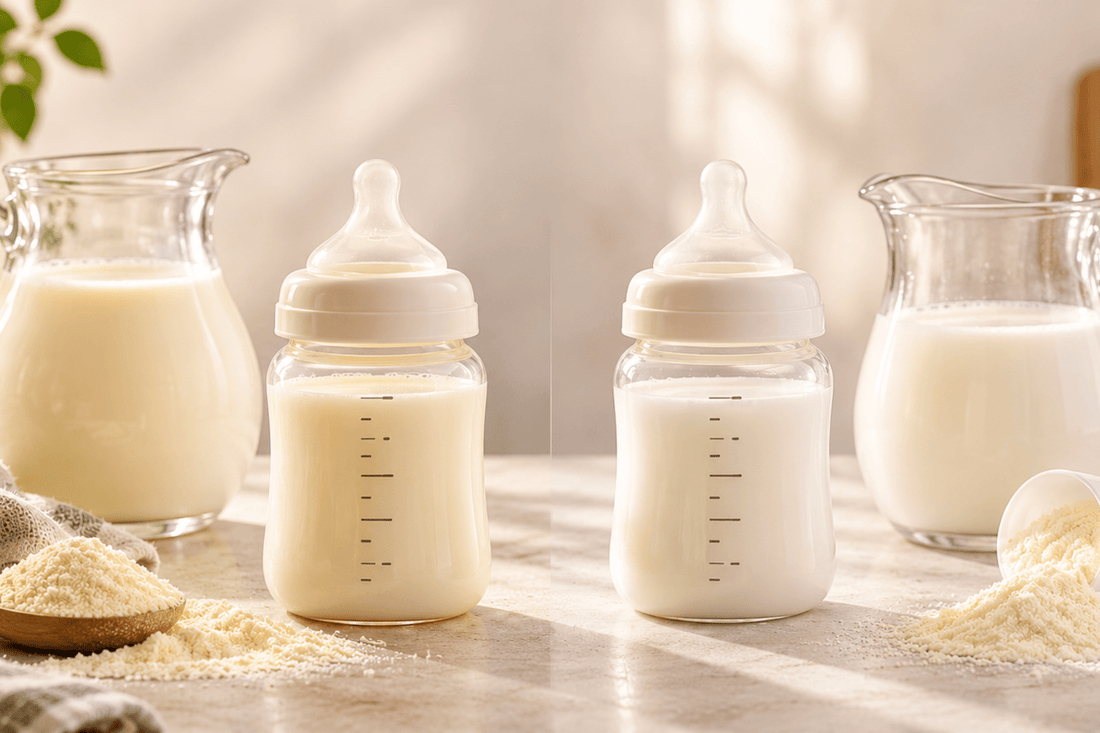
Whole Milk v.s. Skim Milk Baby Formula: What's the Difference?
Table of contents

Ashlen Wilder
Ashlen Wilder is a freelance writer with over seven years of experience covering food, nutrition, business, and consumer products. Her articles on infant nutrition draw from reputable medical and government sources, with an emphasis on evidence-based information to help parents make informed decisions.
Overview
Whole milk formula retains naturally occurring dairy fats, while skimmed milk formula relies more heavily on added oils to meet infants' nutritional needs.
Both whole and skimmed milk-based infant formulas can provide complete nutrition, and neither is inherently better for babies.
European brands like HiPP, Holle, and Kendamil use different milk bases depending on the product, making it important to compare individual formulas rather than brands.
When choosing baby formula, parents have many options: there are cow's milk and goat milk formulas, European vs. American brands, and specialized products for sensitive digestion and allergies. Another phrase that parents might notice on baby formula, and need to make a decision on, is whole milk or skim milk.
While infant formula made from either type of milk can provide the essential nutrients babies need for healthy growth and development, they differ in how their fat content is sourced. In this guide, we'll explore whole milk vs. skim milk formula, their nutritional differences, and what parents should consider when choosing the best formula for their baby.


Choosing between whole and skim milk infant formula
The primary difference between whole milk formula and skim milk formula is the fat. Whole milk contains naturally occurring milk fat, and skim milk has had nearly all its fat removed.¹ Both, however, use a blend of vegetable oils to mimic the fat profile of breast milk.
Whole Milk Formula
Whole milk infant formula uses full-fat dairy milk as an ingredient, retaining the naturally occurring dairy fat. Whole milk contains saturated and unsaturated fatty acids, and baby formula manufacturers may still add additional oils to create the correct fat profile required for baby formula. Some organic whole milk formula products use whole milk powder as a primary dairy ingredient.
Skim Milk Formula
Skim milk is dairy milk that has had most of its naturally occurring fat removed. It is sometimes called nonfat milk. When manufacturers use skim milk to make baby formula, they add more fats from other sources, commonly vegetable oils, to create the required fatty acid composition and energy content for baby formula.
Although the starting ingredient contains very little fat, the finished formula still provides the fat babies need for development. Therefore, skimmed-milk-based formula is not a low-fat food.
Whole Milk vs. Skim Milk Formula: Nutritional Comparison
Both whole and skimmed milk-based infant formulas must meet nutritional standards for whichever country they are produced in.
| Feature | Whole Milk Formula | Skim Milk Formula |
|---|---|---|
| Primary dairy ingredient | Whole milk or whole milk powder | Skimmed milk or skimmed milk powder |
| Naturally occurring dairy fat | Retains some dairy fat | Most dairy fat removed |
| Additional fats | Often includes vegetable oils | Typically relies more heavily on added oils |
Is Whole Milk Formula Better Than Skim Milk Formula?
There is currently insufficient evidence to conclude that whole milk formula is universally better than skimmed-milk-based formula.¹ Manufacturers like Kendamil explain that they use whole milk as the base in order to source fat from the milk fat (rather than only vegetable oils), like breast milk.²
Although whole milk provides naturally occurring dairy fats, both approaches can produce nutritionally complete products that support normal growth. The quality and suitability of a formula depend on its complete composition, not simply whether the manufacturer uses whole or skimmed milk.
Parents may want to consider other formula factors, like:
Age suitability and the manufacturer's feeding instructions.
The overall fat blend and required fatty acids.
Whether the product meets applicable infant formula regulations.
Individual tolerance and any diagnosed feeding or medical concerns.
Availability, price, and consistency of supply.
The best formula is one that is nutritionally appropriate, safe, and well tolerated by the individual baby.

Whole Milk vs. Skim Milk in European Formula
European formula brands use different dairy ingredients depending on their product lines and nutritional formulations. Some formulas feature whole milk as a prominent ingredient, while others use skimmed milk combined with added fats; others use a mix.
Brand |
Stage | Milk Base |
|---|---|---|
Organic First Infant Milk (UK) |
Skimmed milk |
|
Organic Infant Formula Stage 1 |
Skimmed milk |
|
Organic First Infant Milk |
Whole milk |
Milk base refers to the primary dairy milk ingredient in each formula. Some products contain additional dairy ingredients. For example, Kendamil uses whole milk as its primary dairy ingredient but also includes skimmed milk to achieve the desired nutritional composition.
A2 milk is cow's milk that contains only the A2 variant of beta-casein, a type of milk protein. It can be either whole or skimmed milk.


What About Goat Milk Infant Formula?
Goat milk infant formula is another option for parents comparing dairy-based products. Like cow's milk formula, goat's milk formula can be manufactured using whole or skimmed dairy ingredients and must be nutritionally adapted for infants.
Brand |
Formula |
Milk Base |
|---|---|---|
Kendamil |
Goat First Infant Milk |
Whole goat milk |
Holle |
Organic Infant Goat Milk Formula Stage 1 |
Whole goat milk |
HiPP |
Organic Goat Milk PRE |
Skimmed goat milk |
Claims that goat milk formula is consistently easier to digest than cow's milk formula are not firmly established by clinical evidence. Goat milk is not a safe substitute for hypoallergenic formula in babies with cow's milk protein allergy. Proteins from the two animals are similar enough that cross-reactions are common.


Whole Cow's Milk vs Infant Formula
One of the most important distinctions parents should understand is that whole cow's milk and whole-milk-based infant formula are not interchangeable.
Regular cow's milk contains different proportions of protein and minerals than babies need during early infancy. It also lacks sufficient amounts of certain nutrients, particularly iron, to serve as a complete replacement for infant formula.
Whole cow's milk should not be given as a baby's main drink before 12 months of age. Before their first birthday, babies who are not receiving breast milk generally need an age-appropriate infant formula.
After 12 months of age, pasteurized whole cow's milk can usually be introduced as a main drink as part of a balanced diet, according to pediatric guidance and individual nutritional needs.³
Takeaway
The difference between whole milk and skim milk baby formula comes down primarily to the dairy ingredients and sources of fat used during manufacturing.
Whole-milk-based products retain some naturally occurring dairy fat, while skimmed-milk-based products generally obtain a greater proportion of their fats from added oils.
However, both can provide complete, age-appropriate nutrition when manufactured according to applicable infant formula standards. Ultimately, choosing a formula should involve evaluating the entire product, your baby's age and nutritional needs, and how well they tolerate it. Rather than focusing on one ingredient alone, parents can feel confident choosing a properly regulated infant formula that supports their baby's healthy growth and development.
FAQs
Is Whole Milk Formula More Similar to Breast Milk?
Both human milk and whole-milk-based formula contain dairy-derived fats, but their overall compositions are different.
Breast milk includes a complex combination of nutrients and bioactive components that cannot be fully replicated.
A formula made with whole milk may retain certain naturally occurring dairy fat components, but this alone does not make it equivalent or necessarily closer to breast milk in every meaningful respect.
Does Skim Milk Formula Have Less Fat?
Not necessarily. Although skimmed milk itself contains very little fat, manufacturers add appropriate fat sources to the finished formula.
Both types must meet applicable minimum and maximum fat requirements for infant formula.
Can I Use Whole Milk Instead of Formula Before 12 Months?
No. Ordinary whole milk should not replace breast milk or infant formula as a baby's main source of nutrition before 12 months of age.
A properly manufactured infant formula contains an adjusted balance of nutrients specifically designed for babies.
Is Organic Whole Milk Formula Healthier?
Organic certification relates to agricultural production standards rather than proving that a particular formula offers superior health outcomes.
For example, products such as Bobbie Organic Whole Milk use whole-milk ingredients, but parents should evaluate the complete nutritional composition rather than assuming organic or whole-milk ingredients make one product healthier.
Should I Switch My Baby to a Whole Milk Formula?
If your baby is growing well and tolerating their current formula, there is generally no need to switch solely because another product uses whole milk.
Before changing formulas for digestive symptoms, suspected allergies, or growth concerns, consult your pediatrician.
Citations
1. Mead Johnson Nutrition. Whole milk, skim milk, and goat milk in infant formula. Facts About Formula. https://www.factsaboutformula.com/whole-milk-goat-milk-skim-milk-infant-formula
2. Kendamil. Why don't you use skimmed milk? Kendamil. https://eu.kendamil.com/en-es/pages/why-don-t-you-use-skimmed-milk
3. Centers for Disease Control and Prevention. Choosing an infant formula. CDC. https://www.cdc.gov/infant-toddler-nutrition/formula-feeding/choosing-a-formula.html