


Soy-Based Baby Formula Explained
Table of contents

Ashlen Wilder
Ashlen Wilder is a freelance writer with over seven years of experience covering food, nutrition, business, and consumer products. Her articles on infant nutrition draw from reputable medical and government sources, with an emphasis on evidence-based information to help parents make informed decisions.
Overview
- Soy-based baby formula uses soy protein isolate instead of cow's milk protein and is naturally lactose-free
- It is an accepted option for infants with galactosemia or for families following a vegan diet.
- Soy formula is generally not recommended as a treatment for confirmed cow’s milk protein allergy, as some infants with CMPA also react to soy protein.
- It is not suitable for preterm infants due to mineral bioavailability concerns.
- Major European organic formula brands do not currently produce a soy-based line.
Soy based baby formula has been used in infant feeding for decades and remains one of the most recognized non-dairy alternatives to standard cow’s milk formula.
Whether a parent is navigating their child's specific medical condition, a dietary preference, or simply researching their options, understanding what soy formula is helps support a well-informed feeding decision.
This article explains how soy formula is made, which situations it may be appropriate for, what current evidence says about its safety, and how it compares to other formula types on the market.
What Is Soy-Based Baby Formula?
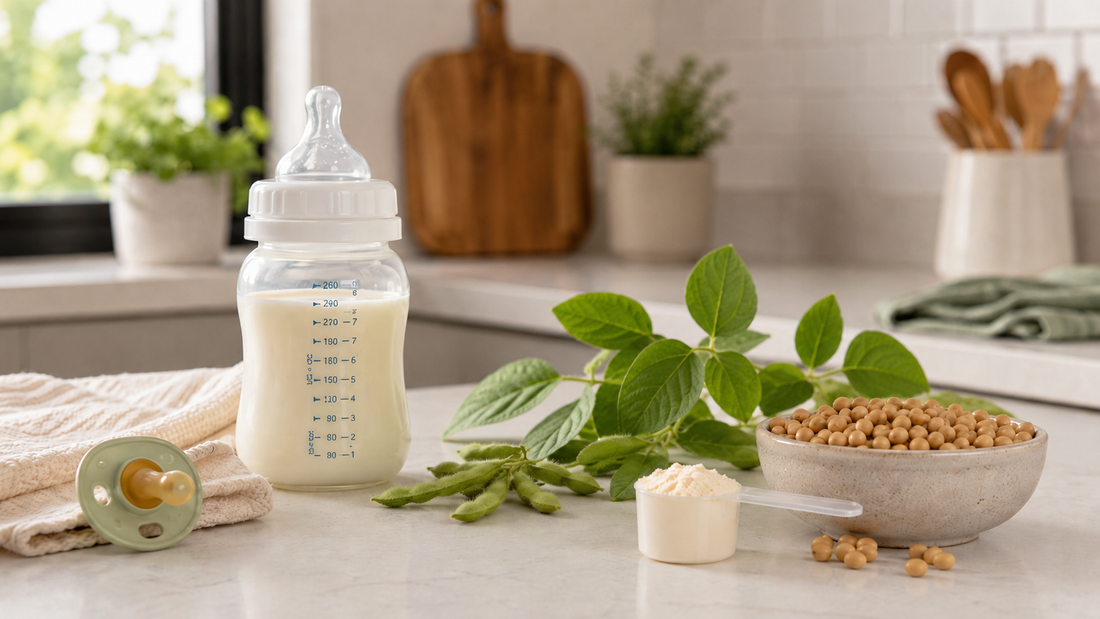
Soybeans are a legume that are naturally high in protein, as well as minerals like potassium, calcium, and magnesium. Soy-based baby formula replaces cow’s milk protein with soy protein isolate, a highly processed form of protein derived from soybeans.
Because soybeans contain no lactose, most soy formulas use corn syrup solids or sucrose as the carbohydrate source, making them lactose-free.¹ In the past, soy-based baby formulas were made from soy flour, but this was found to be causing digestive issues and is no longer used.
Like all infant formulas sold in the United States, soy formula must meet the nutrient requirements set by the FDA, which specify minimum and maximum amounts for 29 nutrients.² Vitamins, minerals, and fatty acids are added to support normal infant growth and development, in accordance with these requirements.
Accepted Uses for Soy-Based Baby Infant Formula
The American Academy of Pediatrics identifies specific situations where soy formula is an appropriate choice for full-term infants.¹
- Galactosemia: Infants with this rare inherited metabolic disorder cannot process galactose, a component of lactose. Soy formula is one of the accepted lactose-free options for these infants under medical supervision.
- Dietary preference: Families who wish to avoid all animal-derived products may choose soy formula as a plant-based alternative to cow’s milk formula.
- Documented lactose intolerance: True primary lactose intolerance in healthy infants is uncommon, but when confirmed, a lactose-free formula such as soy formula may be recommended.
When Soy-Based Formula Is Not Recommended
There are a few misconceptions around when soy-based baby formula is the appropriate choice. Here are situations where it is generally not recommended:
- Infants with cow’s milk protein allergy (CMPA): The AAP has stated that approximately 10–14% of infants with confirmed CMPA also react to soy protein, meaning soy formula cannot always replace cow’s milk formula for this condition.¹ For diagnosed CMPA, a hydrolyzed or amino acid-based formula is the standard approach under medical guidance.
- Preterm infants: ESPGHAN (European Society for Paediatric Gastroenterology, Hepatology and Nutrition) guidelines indicate that its phytate content can reduce the absorption of calcium and phosphorus, minerals critical for bone development in premature babies.³
- Infants with thyroid conditions: should use soy formula only under close medical supervision, as evidence suggests soy isoflavones may affect thyroid function when iodine intake is marginal.¹

Phytoestrogens in Soy-Based Baby Formula
Soy-based baby formula contains isoflavones, which are plant compounds with a weak estrogen-like chemical structure, often called phytoestrogens. Infants who are fed soy formula therefore receive higher isoflavone exposure than infants fed breast milk or cow’s milk formula.¹
After decades of research, neither the AAP nor major regulatory bodies have found evidence of harm to reproductive development in full-term infants fed soy formula at standard intake levels.¹ However, the AAP recommends soy formula only where there is a clear reason, rather than the default.

Soy Formula vs. Cow’s Milk Formula
The table below highlights the key differences between standard soy-based baby formula and standard cow’s milk-based formula.
Feature |
Soy Formula |
Cow’s Milk Formula |
|---|---|---|
Protein source |
Soy protein isolate |
Cow’s milk whey and/or casein |
Carbohydrate source |
Corn syrup solids or sucrose |
Primarily lactose |
Lactose content |
Lactose-free |
Contains lactose |
Suitable for CMPA |
Generally not recommended |
Not suitable — is the allergen |
Suitable for galactosemia |
Yes, under medical guidance |
No |
Phytoestrogens |
Yes |
No |
Suitable for preterm infants |
Not recommended |
Specialized preterm options available |
Organic EU options |
Not available from EU organic brands |
Widely available |
Soy Formula and the European Organic Market
Soy-based baby formula is not part of the European organic formula category. Brands such as HiPP, Holle, and Kendamil focus on cow’s milk and goat’s milk bases, governed by EU Regulation 2016/127.⁵ No soy-based infant formula is currently available from these brands. However, some European brands like Bébé M or Prémiriz use hydrolyzed rice protein for a dairy-free option.
Parents exploring dairy-free formula options should speak with their pediatrician to identify an appropriate formula based on the individual infant’s health needs.
Takeaway
Soy-based baby formula is an established option for specific situations like galactosemia and vegan feeding preferences, but it is not a universal substitute for cow’s milk formula. While it is lactose-free, in most cases of cow’s milk protein allergy, soy-based formula is not the first choice. Always consult a pediatrician before switching to or starting soy formula. Parents exploring different types of baby formula or searching for baby formula developed for allergies should always consult with their pediatrician to determine what is best for the individual infant’s health and specific needs.
FAQs
Can I use soy-based baby formula if my baby has a cow’s milk allergy?
Soy formula is generally not recommended as a first-line treatment for confirmed cow’s milk protein allergy. A percentage of infants with CMPA also react to soy protein. A hydrolyzed or amino acid-based formula is usually recommended instead. Always consult your pediatrician for a diagnosis and formula guidance.
Is soy formula safe given the phytoestrogens it contains?
Current evidence reviewed by the AAP has not identified harm to reproductive development from soy formula phytoestrogens. However, long-term research continues, and the AAP advises using soy formula only when there is a specific clinical or dietary reason to do so.
Does soy formula cause constipation?
Some infants may experience firmer stools on soy formula due to its different protein and carbohydrate composition. If you notice significant changes in your baby’s bowel habits, speak with your pediatrician.
Is soy formula lactose-free?
Yes. Most soy formulas use corn syrup solids or sucrose as the primary carbohydrate and contain no lactose, which is why they are used for infants with galactosemia or confirmed lactose intolerance.
Do European organic formula brands make a soy version?
No. HiPP, Holle, and Kendamil do not produce soy-based formulas. Their product ranges are built around cow’s milk and goat’s milk. If you need a soy-based formula, your pediatrician can recommend an appropriate product. Some European brands offer a milk-free, hydrolyzed rice formula.
Citations
1. Fuchs GJ III, Abrams SA. Choosing a baby formula. HealthyChildren.org. Updated October 20, 2023. Accessed July 31, 2026. https://www.healthychildren.org/English/ages-stages/baby/formula-feeding/Pages/choosing-an-infant-formula.aspx
2. U.S. Food and Drug Administration. Infant Formula Homepage. Updated July 16, 2026. Accessed July 31, 2026. https://www.fda.gov/food/resources-you-food/infant-formula-homepage
3. ESPGHAN Committee on Nutrition, Agostoni C, Axelsson I, Goulet O, et al. Soy protein infant formulae and follow-on formulae: a commentary by the ESPGHAN Committee on Nutrition. J Pediatr Gastroenterol Nutr. 2006. https://pubmed.ncbi.nlm.nih.gov/16641572/
4. Centers for Disease Control and Prevention. Infant and Toddler Nutrition: Formula Feeding. https://www.cdc.gov/nutrition/infantandtoddlernutrition/formula-feeding/index.html
5. European Commission. Commission Delegated Regulation (EU) 2016/127 on infant formula and follow-on formula. https://eur-lex.europa.eu/legal-content/EN/TXT/?uri=CELEX%3A32016R0127