


Corn Syrup in Baby Formula Explained
Table of contents

Ashlen Wilder
Ashlen Wilder is a freelance writer with over seven years of experience covering food, nutrition, business, and consumer products. Her articles on infant nutrition draw from reputable medical and government sources, with an emphasis on evidence-based information to help parents make informed decisions.
Overview
Corn syrup solids are used as a carbohydrate source in some American infant formulas, especially for lactose-sensitive, soy-based, and hypoallergenic varieties.
Corn syrup solids are not the same as high-fructose corn syrup (HFCS); they are glucose polymers similar to maltodextrin, with no added fructose.
The FDA classifies corn syrup solids as Generally Recognized as Safe (GRAS) for use in infant formula.
EU Regulation 2016/127 requires lactose to be the predominant carbohydrate in standard cow-milk infant formula, so EU organic brands do not use corn syrup solids.
If you've ever turned over a container of infant formula and spotted corn syrup in the ingredient list, you're not alone in wondering if it belongs in your baby's bottle. The term sounds alarming, especially since sugar syrups can contribute to obesity and issues with metabolic health.
Some infant formula companies use corn syrup solids as a carbohydrate source for specific nutritional and medical purposes. While some parents intentionally avoid formula with corn syrup, the ingredient is regulated differently from high-fructose corn syrup and serves a different function.
This article explains what corn syrup solids actually are, why some U.S. formulas include them, what the FDA says about their safety, and how European formula brands approach carbohydrate sourcing differently.

What Are Corn Syrup Solids?
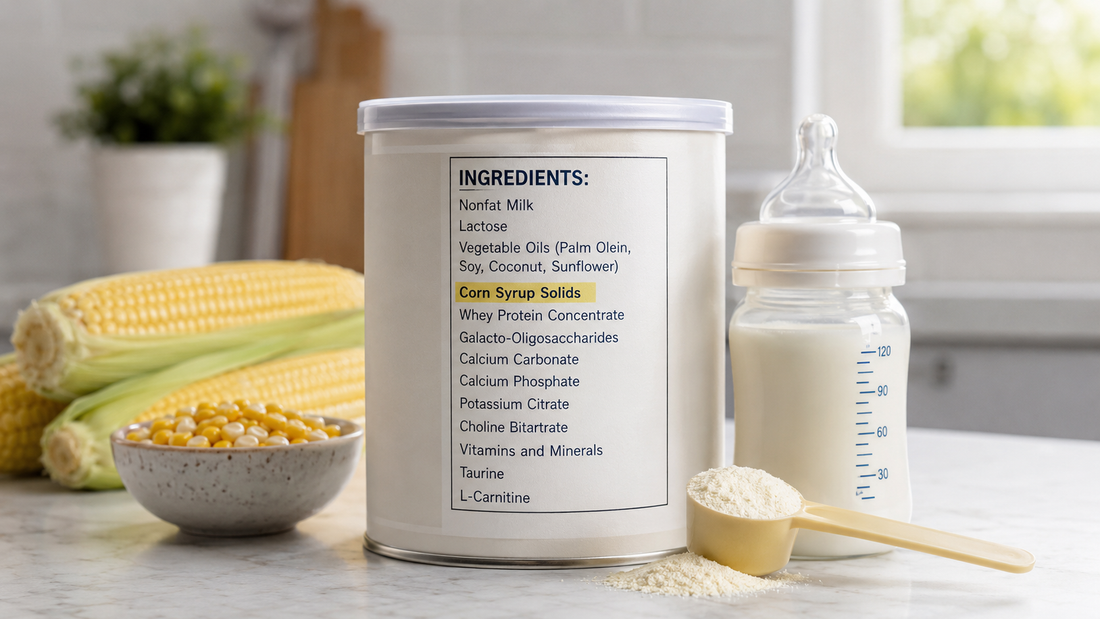
Corn syrup solids, sometimes labeled as glucose syrup solids, are made by partially hydrolyzing corn starch, or by breaking it down into smaller pieces of sugar. Those pieces are mostly glucose-based because corn starch naturally breaks down into glucose, not fructose. So even though the name sounds similar to high-fructose corn syrup, corn syrup solids are a different glucose ingredient.
In baby formula, glucose-based ingredients like corn syrup solids are used as carbohydrate sources that are easy to digest, while fructose is generally avoided because infants have limited ability to process it safely in large amounts.¹
This is a critical distinction: corn syrup solids are not high-fructose corn syrup (HFCS). HFCS is produced through an additional enzymatic step that converts a significant portion of glucose into fructose.²
Why Do Some Baby Formulas Contain Corn Syrup Solids?
In infant formula, carbohydrates provide energy for growth and development. Breast milk contains lactose, a carbohydrate, and as a result, this is the preferred carbohydrate in most standard formulas. However, not every baby has the ability to digest lactose, and some specialty formula products are designed for this reason. Corn syrup solids provide an easily digested alternative carbohydrate that can help provide energy for your baby when lactose is not the best option.³
Is Corn Syrup in Formula Safe? What the FDA Says
The FDA regulates infant formula as a food product under 21 CFR Part 106 and Part 107. Corn syrup solids are simply dried corn syrup, which is recognized as GRAS under FDA regulations when used in food at levels consistent with good manufacturing practice. In infant formula, any use must also comply with FDA infant formula requirements for safety, nutrition, labeling, and manufacturing.
The FDA also requires that infant formulas meet strict minimum and maximum nutrient standards for energy, protein, fat, and carbohydrate content, regardless of which carbohydrate source is used.
While it is approved for infant formula, one study has shown slightly adverse effects with the ingredient. Infants who were fed formula made with corn syrup solids instead of lactose became more likely over time to show food fussiness and picky eating, compared with infants fed traditional lactose-based formula or breast milk. The early exposure to a sweeter carbohydrate source may shape babies’ taste preferences, making them more drawn to sweet foods and less accepting of bitter foods like some vegetables.
EU Regulations and Organic Formula: Lactose and Corn Syrup
Parents researching European infant formula might notice that EU organic formulas do not list corn syrup solids on their labels. This is due to the fundamentally different regulatory framework.
EU Regulation 2016/127 specifies that in standard cow-milk-based infant formula, lactose must be the predominant carbohydrate source, accounting for at least 70%. Other permitted carbohydrates include maltodextrin, glucose syrup, and pre-cooked starch, but these may only supplement, not replace, lactose as the main carb.⁶
The European Society for Paediatric Gastroenterology, Hepatology and Nutrition (ESPGHAN) supports this standard, noting that lactose closely mirrors the carbohydrate profile of human breast milk and is appropriate for most healthy infants.⁷
EU organic certification adds another layer: brands certified under EU organic rules must source ingredients from certified organic agriculture, and their formulations are independently audited. HiPP, Holle, and Kendamil, three of the most widely used EU organic formulas, all use organic lactose as their primary carbohydrate in their Stage 1 (infant) formulas. None of these brands use corn syrup solids, but in follow-on stages, starch or maltodextrin from other certified sources may appear.⁸
Carbohydrate Source Comparison: US Conventional vs. EU Organic Formula
The table below summarizes how carbohydrate sourcing typically differs between US conventional infant formulas and EU organic infant formulas. Individual products vary, so always check the label of the specific formula you are considering.
Feature |
US Conventional Formula (standard cow-milk) |
EU Organic Formula (e.g., HiPP, Holle, Kendamil) |
|---|---|---|
Primary carbohydrate |
Varies, may be lactose, corn syrup solids, or a blend |
Lactose required for predominant carb source |
High-fructose corn syrup (HFCS)? |
Not permitted in infant formula |
Not permitted in infant formula |
Suitable for galactosemia? |
Yes, soy/amino acid formulas with corn syrup solids are suitable |
Standard lactose-based EU formulas are NOT suitable; specialized formulas required |
Taste considerations |
Corn syrup solids can make formula taste sweeter |
Lactose-based formulas closely mirror the taste of breast milk |
HiPP, Holle, and Kendamil: What They Use Instead
If you are exploring EU organic formulas as an alternative to US conventional formulas that contain corn syrup solids, understanding what these brands use as their carbohydrate source is helpful.
HiPP formulas use organic lactose as the sole carbohydrate in their Stage 1 infant formula. HiPP is certified under EU organic regulations and holds the Bioland and Demeter certifications in some product lines, which carry additional standards beyond the baseline EU organic rules. Their follow-on formulas (Stage 2 and Stage 3) may include small amounts of organic starch, but lactose remains the predominant carbohydrate source. Learn more about HiPP formula ingredients.
Holle formulas are Demeter biodynamic certified, one of the strictest organic certifications available. Their Stage 1 formulas use organic lactose as the sole carbohydrate, and their follow-on stages use lactose combined with organic starch. No corn syrup solids are used at any stage. See the full breakdown of Holle formula ingredients.
Kendamil is a UK-based brand that continues to follow EU-derived organic standards and uses whole organic milk with organic lactose as the carbohydrate source. Kendamil's formulas also stand out for including whole milk fat. More details are available on Kendamil formula ingredients.
Parents comparing these options with US conventional formulas can find a broader overview of the best organic baby formula choices currently available.
When Corn Syrup Solids Make Sense in Infant Formula
While many formula products are made with lactose, there are situations where formula made with corn-syrup solids is medically appropriate. For example:
- Infants diagnosed with galactosemia cannot safely consume lactose-based formula because lactose breaks down into glucose and galactose, and these infants are unable to properly metabolize galactose. For these babies, soy-based or amino acid-based infant formula made with corn-syrup solids as the primary source of carbohydrate is a medically necessary alternative.³
- Infants with a documented cow’s milk protein allergy (CMPA) require extensively hydrolyzed or amino acid-based formulas, and may be fed a lactose-reduced or lactose-free formula containing corn syrup solids. These specialized products often use corn syrup solids or other glucose-based carbohydrates to provide energy while reducing or avoiding lactose.³
In these clinical contexts, the presence of corn syrup solids in a formula is not a red flag, but part of the formula's intended nutritional design.

How to Read a Formula Ingredient Label for Sugar
US food labeling rules require ingredients to be listed in descending order by weight. If corn syrup solids appear as the first or second ingredient on a formula label, they constitute a large proportion of the formula by weight and are likely the primary carbohydrate source.
Common names to look for when checking carbohydrate sources include:
Lactose — the preferred carbohydrate in breast milk and EU-regulated standard infant formula
Corn syrup solids or glucose syrup solids — glucose polymers derived from corn starch; not HFCS
Maltodextrin — similar to corn syrup solids in structure; can be derived from corn, rice, or other starches
Sucrose — permitted in some specialized formula types but generally not permitted for standard infant formula due to its sweetness and dental concerns⁷
Starch — used in small amounts in some follow-on formulas as a thickening agent, distinct from corn syrup solids
Takeaway
Corn syrup solids in baby formula are a glucose-based carbohydrate, not high-fructose corn syrup, and they are FDA permitted for use in infant formula in the United States. They serve a legitimate purpose in soy-based, hypoallergenic, and amino acid-based formulas designed for infants who cannot tolerate lactose.
However, their presence in mainstream cow-milk standard formulas is a US-specific formulation practice, not a nutritional requirement for healthy term infants. European takes a different approach, requiring lactose to predominate in standard cow-milk infant formula. This is why EU organic brands like HiPP, Holle, and Kendamil use organic lactose as their primary carbohydrate and do not include corn syrup solids at any stage.
FAQs
Is corn syrup in baby formula the same as high-fructose corn syrup?
No. Corn syrup solids (also called glucose syrup solids) are glucose polymers made from corn starch. They contain negligible fructose. High-fructose corn syrup (HFCS) undergoes an additional enzymatic process that converts a large portion of glucose into fructose, resulting in a product that is 42–55% fructose. HFCS is not used or permitted in infant formula. The two ingredients are chemically and functionally distinct.
Is corn syrup in baby formula safe for my infant?
The FDA classifies corn syrup solids as GRAS (Generally Recognized as Safe) and permits their use in infant formula. One study has shown that it does appear to alter the taste preferences of infants. That said, for healthy full-term infants, lactose is the carbohydrate that most closely mirrors breast milk. If you have concerns, discuss them with your pediatrician, who can help you choose a formula appropriate for your infant's individual health needs.
Why do some US baby formulas use corn syrup solids instead of lactose?
Corn syrup solids are used in formulas designed for infants who cannot tolerate lactose, including soy-based formulas for galactosemia or family preference, and hypoallergenic or amino acid-based formulas for cow-milk protein allergy. Some US standard cow-milk formulas also use them as a partial carbohydrate source — this is a manufacturer formulation choice, not a medical requirement.
Do European organic formulas like HiPP, Holle, and Kendamil contain corn syrup solids?
No. EU Regulation 2016/127 requires lactose to be the predominant carbohydrate in standard cow-milk infant formula. EU organic certification adds further ingredient sourcing requirements. HiPP, Holle, and Kendamil all use organic lactose as their primary carbohydrate in Stage 1 (infant) formulas and do not use corn syrup solids at any stage.
What carbohydrate is in breast milk, and how do formulas compare?
Human breast milk contains lactose as its primary carbohydrate. European organic formulas with lactose as the predominant carbohydrate are formulated to match this profile closely. US formulas that use corn syrup solids as the primary carbohydrate differ from breast milk's natural carbohydrate composition, though they still meet FDA nutrient standards for infant formula.
Citations
1. U.S. Food and Drug Administration (FDA). Infant Formula: Guidance, Compliance & Regulatory Information. https://www.fda.gov/food/guidance-documents-regulatory-information-topic-food-and-dietary-supplements/infant-formula-guidance-documents-regulatory-information
2. U.S. Food and Drug Administration (FDA). High Fructose Corn Syrup: Questions and Answers. https://www.fda.gov/food/food-additives-petitions/high-fructose-corn-syrup-questions-and-answers
3. American Academy of Pediatrics (AAP) / HealthyChildren.org. Soy Formula. https://www.healthychildren.org/English/ages-stages/baby/formula-feeding/Pages/choosing-an-infant-formula.aspx
4. American Academy of Pediatrics (AAP). Policy Statement: Added Sugars and Cardiovascular Risk in Children. Pediatrics, 2016. https://www.healthychildren.org/English/healthy-living/nutrition/Pages/How-to-Reduce-Added-Sugar-in-Your-Childs-Diet.aspx
5. European Commission. Commission Delegated Regulation (EU) 2016/127 of 25 September 2015 supplementing Regulation (EU) No 609/2013 of the European Parliament. Official Journal of the European Union, 2016. https://eur-lex.europa.eu/legal-content/EN/TXT/?uri=CELEX%3A32016R0127
6. Fewtrell M, et al. / ESPGHAN Committee on Nutrition. Complementary Feeding: A Position Paper by the European Society for Paediatric Gastroenterology, Hepatology and Nutrition (ESPGHAN). Journal of Pediatric Gastroenterology and Nutrition, 2017. https://pubmed.ncbi.nlm.nih.gov/28027215/
7. National Institutes of Health (NIH) / National Library of Medicine. Lactose Intolerance in Infants and Galactosemia: Overview of Dietary Management. https://www.ncbi.nlm.nih.gov/books/NBK532285/