


HiPP PRE Formula



What Is HiPP Combiotic Pre Formula and Who Is It For?
HiPP Combiotic Pre Formula is a starting formula intended for newborns from birth onward. The "pre" designation refers to formulas that are nutritionally complete as a sole source of nourishment for babies in their earliest weeks and months of life, typically from birth up to around six months of age. This milk formula, sometimes called first infant formula,1 is designed to align as closely as possible with the nutritional composition needed for newborns; it does not contain any added starches and is easy to digest.
HiPP, a family-owned German brand with decades of experience in organic farming and infant nutrition, produces its pre formula under strict European organic standards. Whether you are exclusively formula feeding or supplementing alongside breastfeeding, HiPP Pre is designed to support the first months of your baby's life.
If you are exploring European formula options for your child, browse our complete selection of Organic Formulas.
HiPP Bio Pre vs. HiPP HA Pre Formula
HiPP's Pre range is intended for the same age but comes in two distinct formulations for different feeding needs. Each variety is sold in a 600 g pack.
Both the standard and hypoallergenic formulations are described as combiotic (combiotik in German), which refers to the combination of a prebiotic fiber (GOS) and a natural lactic-acid culture (Limosilactobacillus fermentum).2
Standard HiPP Bio Combiotic Pre Formula
The standard HiPP Pre Formula is made using certified organic cow's milk and uses lactose as the sole carbohydrate source. It also contains a blend of organic vegetable oils and a full panel of vitamins and minerals calibrated to a newborn's needs, and it carries the EU organic certification, backed by HiPP's own quality standards that go beyond the legal requirements. What that certification involves is explained below.
HiPP HA Combiotic Pre Formula
The HiPP HA Pre Formula is a hypoallergenic, partially hydrolyzed version of the standard Pre formula. In this variant, the whey proteins are broken down into smaller fragments through a process called hydrolysis. It is produced under HiPP's strict quality standards and is made without genetically modified ingredients. Because the hydrolyzed whey protein it requires cannot be sourced in organic quality, the HiPP HA Pre does not carry the Bio label or the EU organic certification.
Parents exploring easier-to-digest protein options for newborns who do not tolerate a standard formula well may find the HiPP hypoallergenic formula a suitable choice. While this formula is not suitable for a true cow's milk protein allergy, it can be a gentler option for babies who are sensitive to standard cow's milk formula. Before choosing a specialty formula, parents are encouraged to speak with their child's pediatrician.
You can explore the full HiPP HA Formula collection to see all available options.
What Makes HiPP Infant Formula Organic
All ingredients in the standard HiPP Pre Formula that can be sourced organically are certified organic, including the milk base. HiPP has sourced milk from farms that have practiced sustainable, chemical-free agriculture for decades.
European organic certification for infant formula requires that dairy cows graze on organically managed pastures and are not treated with synthetic growth hormones or routine antibiotics. Feed must also meet organic standards, and the entire production chain is subject to regular independent auditing. HiPP layers its own additional quality controls on top of these requirements, resulting in a transparent and traceable formulation that can sometimes be challenging to find in the American infant nutrition market.
Those interested in a comprehensive view of what European organic infant nutrition looks like across different brands and stages can browse our European Formula collection.
Key Ingredients and Nutritional Composition
Understanding what goes into the German formula will help parents in the United States feel more confident and informed when making decisions on what formula is best for their baby. Europe has some of the strictest regulations for baby formula in the world, and the nutritional composition of HiPP Pre is designed to align with the guidelines established by the European Food Safety Authority (EFSA).5
Core Nutritional Ingredients
The protein base of the standard HiPP Pre is derived from organic skimmed milk and organic whey, while the HiPP HA Pre formula uses a base of lactose and hydrolyzed whey protein. The primary carbohydrate source of both is lactose, which is the naturally occurring sugar found in breast milk.
For healthy fat, both formulas use a blend of vegetable oils (palm, rapeseed, and sunflower) that provides omega-3 and omega-6 fatty acids. In the standard HiPP Pre these oils are organic; in the HA Pre they are not, in line with its non-organic status.
DHA, a long-chain omega-3 fatty acid, is added as required for European infant formula. Research indicates that DHA is important for the growth and functional development of the brain in infants.3 The formula is enriched with a comprehensive range of vitamins and minerals, including vitamin K, vitamin E, vitamin B12, vitamin D, vitamin C, calcium, iron, and more.
HiPP Pre contains the prebiotic fiber galacto-oligosaccharides (GOS) and a natural lactic-acid culture (Limosilactobacillus fermentum). 2,4
How to Prepare HiPP Pre Formula Correctly
The preparation steps are the same for the standard HiPP Pre and the HiPP HA Pre Formula.
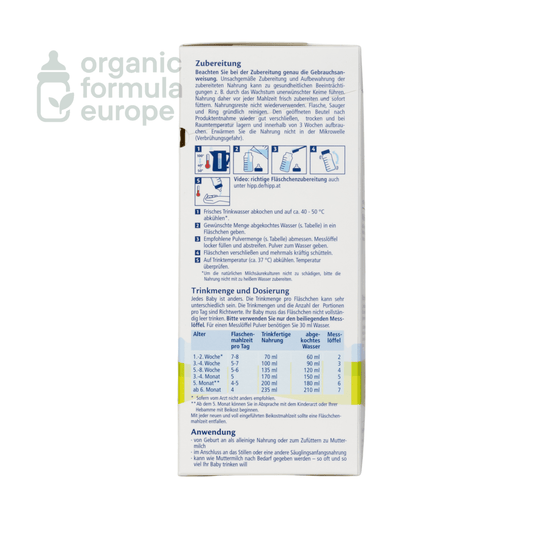
Wash your hands and sterilize all feeding equipment, including bottles and nipples. Bring freshly drawn water to a full boil, then let it cool before mixing. Recommendations on the mixing temperature differ: HiPP's tin instructions suggest around 122°F (50°C) for optimal mixing, while the U.S. CDC recommends water no cooler than 158°F (70°C) to reduce the risk of Cronobacter, since powdered formula is not sterile. Follow the guidance on your tin, and if you use hotter water, let the prepared bottle cool to body temperature before feeding.
Pour about two-thirds of the required water into the bottle, then add the correct number of level scoops using only the scoop provided in the box, following the mixing chart on your tin. Scoop sizes vary between brands and batches, so never substitute another scoop. Close the bottle and shake until the powder is fully dissolved, add the remaining water, and shake again. Test the temperature on the inside of your wrist before feeding.
Discard any prepared formula not used within two hours. Once opened, use the tin within three weeks, stored in a cool, dry place away from sunlight. Never strengthen or dilute the formula beyond the recommended amounts.
Choosing Between HiPP Pre and HiPP Formula Stage 1
HiPP offers quite a few options, with formulas for different ages and nutrition needs. Therefore, a common question among parents is whether to choose HiPP Pre Formula or move directly to HiPP Formula Stage 1.
HiPP Pre is designed specifically for newborns from birth, and uses only lactose as its carbohydrate source. This makes it suited for the earliest weeks of life and the development of digestive systems.
HiPP Formula Stage 1, on the other hand, contains a slightly different carbohydrate profile, incorporating a small amount of starch in addition to lactose. The purpose of this is to make it feel more satiating for babies who feed more often and are frequently hungry. This addition will also make the formula slightly thicker than the stage pre is.
Both formulas can be fed to babies from birth to around six months of age, and both meet European standards for complete infant nutrition. The choice between them often comes down to your baby's individual feeding rhythm and your pediatrician's suggestions.
Parents may begin with HiPP Pre, which has a thinner, lactose-only composition suited to the earliest weeks, and transition to HiPP Formula Stage 1 as their baby grows and appetite increases, typically around the two to three month mark.
As your baby continues to grow and approaches the six-month milestone, you may also want to explore what comes next in the HiPP range. The HiPP Formula Stage 2 is designed to complement the introduction of solid foods and support your baby's expanding nutritional needs as they become more active and reach new developmental milestones.
If you are ever unsure which formula is right for your baby's stage and appetite, speaking with your pediatrician is always recommended.
Frequently Asked Questions
What is HiPP Pre Formula used for?
HiPP Pre Formula is a complete infant formula designed for newborns from birth up to approximately six months of age. It is formulated to serve as the sole source of nutrition during this stage of life, either as an alternative to breastfeeding or as a complement to it. It aligns with European nutritional standards for newborns and uses lactose as its only carbohydrate source.
What is the difference between HiPP Pre and HiPP HA Pre Formula?
HiPP Pre Formula is made with standard organic whey and skimmed milk proteins, while HiPP HA Pre Formula uses hydrolyzed, or partially broken down, whey proteins. The standard Pre formula carries EU organic certification, while the HA Pre version does not, due to the hydrolysis process. Parents who are curious about which option may be appropriate for their newborn should always consult with their pediatrician.
How do I prepare HiPP Pre Formula?
Bring fresh water to a full boil and let it cool before mixing. HiPP's tin instructions suggest cooling to around 122°F (50°C), while the U.S. CDC recommends water no cooler than 158°F (70°C) to reduce the risk of Cronobacter in non-sterile powder; follow the guidance on your tin and let the bottle cool to body temperature before feeding. Pour two-thirds of the required water into a sterilized bottle, add the correct number of level scoops using the scoop provided, shake well, add the remaining water, and shake again. Always follow the exact ratio on the packaging, test the temperature before feeding, and discard any unused prepared formula after two hours.
Is HiPP Pre Formula organic?
Yes, the standard HiPP Pre Formula is certified organic under European organic standards. This means the milk used comes from cows raised on organically managed farms without synthetic pesticides, GMOs, or routine antibiotics. HiPP also applies its own internal quality standards that go beyond the legal requirements, ensuring a high level of transparency and traceability throughout the production process.
Please note that the HiPP HA Pre Formula is not certified organic and is non-GMO. Because the hydrolyzed whey protein it requires cannot be sourced in organic quality, the HA Pre does not carry the Bio label.
How long can I use HiPP Pre Formula before switching to Stage 1?
HiPP Pre Formula is suitable from birth through the first six months of life. Many parents choose to use it throughout this entire period, while others transition to a Stage 1 formula between two and four months if their baby shows signs of greater hunger. There is no strict rule, and the decision can depend on your baby's individual appetite and feeding patterns, as well as your pediatrician's recommendations.
How should I store an opened tin of HiPP Pre Formula?
Once opened, the powder should be stored in a cool, dry place with the lid securely closed and away from direct sunlight or heat sources. An opened container should be used within three weeks of opening for optimal freshness and quality. Always use the scoop provided and avoid introducing moisture to the container, as this can affect the powder's quality and texture.
References:
- NHS. Types of formula milk. NHS; 2023. https://www.nhs.uk/baby/breastfeeding-and-bottle-feeding/bottle-feeding/types-of-formula/
- HiPP. HiPP ORGANIC COMBIOTIC®. HiPP for Health Care Professionals. 2026. https://hcp.hipp.com/products/hipp-milk-formulae/combiotic/
- Horrocks LA, Yeo YK. Health benefits of docosahexaenoic acid (DHA). Pharmacol Res. 1999 Sep;40(3):211–225. doi: 10.1006/phrs.1999.0495. PMID: 10479465 https://pubmed.ncbi.nlm.nih.gov/10479465/
- Mei Z, Yuan J, Li D. Biological activity of galacto-oligosaccharides: A review. Front Microbiol. 2022 Sep 6;13:993052. doi:10.3389/fmicb.2022.993052. PMCID: PMC9485631. https://pmc.ncbi.nlm.nih.gov/articles/PMC9485631/
- European Food Safety Authority (EFSA). Foods for infants and other groups. EFSA; last reviewed 15 Feb 2024 https://www.efsa.europa.eu/en/topics/topic/foods-infants-and-other-groups
European Baby Formula Brands
-

HiPP Formula
HiPP Formula, Organic European Infant Nutrition from Birth to Toddler For more...
-

Holle Formula
Confused About Holle Formula? Start Here There’s no shortage of options when...
-

Kendamil Formula
Kendamil Formula, British Whole Milk Infant Nutrition Choosing the right formula is...


