


HiPP Organic Baby Formula - Stage 3
For 10+ months · 21.2 oz (600 g)


HiPP Organic Baby Formula - Stage 3
In stock
Estimated delivery: 2–5 days
Secure checkout
Couldn't load pickup availability
Express shipping from Germany
Every order ships with express delivery and tracking. Free on orders over $125.
Original EU packaging
Factory sealed and never repacked. You receive the product exactly as it was made.
Long shelf life
At least 6 months until the best-before date when your order ships.
Checked by hand
Seal and best-before date are checked before every order ships.
HiPP Organic Baby Formula Stage 3 for Babies 10 to 12 Months
HiPP Organic Baby Formula Stage 3 is a German Combiotik growing-up milk for babies from around 10 to 12 months, intended to complement a diet that now includes a variety of solid foods. Made by a fourth-generation family company with roots going back to 1899, it is EU organic certified and produced in Germany. As always, your pediatrician is the best guide for when and whether a growing-up formula is appropriate for your child.
HiPP's Organic Farming Heritage
Founded in 1899 and still family-owned under fourth-generation Stefan Hipp, HiPP has over 125 years expertise in infant nutrition. Stage 3 carries the EU organic certification (DE-ÖKO-001) and the HiPP Organic Seal, which reflects HiPP's own quality standards beyond the legal organic minimum.
The formula is produced in Germany, and is EU organic but not Demeter-certified. It is part of the same Combiotik family as HiPP German Stage 1 and Stage 2, giving parents continuity across the first year and beyond.
What Stage 3 Is and Who It Is For
Stage 3 is designed for babies from approximately 10 to 12 months who are well established on solid foods. At this stage, formula becomes a complement to a varied diet rather than the primary source of nutrition. The Combiotik system continues into Stage 3, combining GOS and natural lactic acid cultures (Limosilactobacillus fermentum).
If your family has been using HiPP Organic Formula through the earlier stages, Stage 3 provides a consistent continuation of the same organic, Combiotik-based approach. For babies moving toward toddler milk, this stage also serves as a bridge before transitioning to HiPP Toddler Formula.
Ingredients and Composition
Stage 3 is based on organic skimmed cow's milk and an organic whey product, providing intact cow's milk protein. The carbohydrate profile includes lactose as the primary sugar along with a higher proportion of specially selected organic starch, which gives the formula a creamier consistency that is filling and appropriate for older babies.
Organic palm oil is included as part of the vegetable oil blend. DHA is sourced from fish oil. ARA is not present in Stage 3. GOS and natural lactic acid cultures (Limosilactobacillus fermentum) complete the Combiotik system. No soy protein is used. The formula is certified to EU organic regulation (DE-ÖKO-001) and is not Demeter-certified.
Genuine European Formula from Organic Formula Europe
Organic Formula Europe ships authentic German HiPP Stage 3 directly from European supply chains to parents in the United States. Each pack is identical to what is sold in German pharmacies: sealed, within date, and printed with the European DD/MM/YYYY best-before format on the base.
HiPP German formula is manufactured in Germany and subject to EU food safety regulations, which include mandatory DHA levels and strict controls on pesticide residues. These standards differ from US domestic formula regulations, and discussing any formula change with your pediatrician is always recommended.
Preparation and Everyday Use
Mix each serving fresh following the feeding guide and scoop size on the carton. Powdered formula is not sterile, so using water at the temperature specified on the packaging and discarding unused prepared formula within the stated time is important. Stage 3 is typically used as one component of a varied diet rather than the sole source of nutrition.
Once opened, use the contents within 3 weeks. Keep the sealed carton in a cool, dry place away from heat and direct sunlight.
Packaging at a Glance
- 600g carton with a resealable inner bag
- Includes a measuring scoop
- Best-before date in European DD/MM/YYYY format on the base
- EU organic (DE-ÖKO-001)
Nutrition Facts (per 100 mL / 3.38 fl oz of prepared formula)
- Energy: 285 kJ / 68 kcal
- Fat: 3.7 g
- Saturated fatty acids: 1.6 g
- Monounsaturated fatty acids: 1.6 g
- Polyunsaturated fatty acids: 0.5 g
- Alpha-linolenic acid (ALA): 0.06 g
- Docosahexaenoic acid (DHA): 13.6 mg
- Linoleic acid (LA): 0.42 g
- Total Carbohydrates: 7.1 g
- Sugars: 5.7 g
- Lactose: 5.5 g
- Starch: 1.4 g
- Fiber: 0.4 g
- Protein: 1.4 g
- Sodium: 20 mg
- Biotin: 1.6 µg
- Calcium: 77 mg
- Chloride: 52 mg
- Iron: 1 mg
- Fluoride: < 0.01 mg
- Folic acid: 11.3 µg
- Iodine: 15 µg
- Potassium: 88 mg
- Copper: 0.054 mg
- Magnesium: 6.3 mg
- Manganese: 0.007 mg
- Niacin: 0.53 mg
- Pantothenic acid: 0.35 mg
- Phosphorus: 44 mg
- Selenium: 3.9 µg
- Vitamin A: 56 µg
- Thiamine (Vitamin B1): 0.051 mg
- Riboflavin (Vitamin B2): 0.15 mg
- Vitamin B6: 0.042 mg
- Vitamin B12: 0.1 µg
- Vitamin C: 10 mg
- Vitamin D: 1.6 µg
- Vitamin E: 0.8 mg
- Vitamin K: 3.9 µg
- Zinc: 0.5 mg
- Galactooligosaccharides (GOS): 0.4 g
| Age | Ready-to-drink formula (ml / fl oz) | Amount of water (ml / fl oz) | # of Scoops |
|---|---|---|---|
| 10+ months | 170 / 5.7 | 150 / 5.1 | 5 |
| 10+ months | 200 / 6.8 | 180 / 6.1 | 6 |
| 10+ months | 235 / 7.9 | 210 / 7.1 | 7 |

How to Prepare Powdered Formula
- Boil fresh water for each feed and let it cool to the temperature printed on your can. Powdered infant formula is not sterile, so the CDC and WHO advise that water at about 158°F (70°C) lowers the risk of Cronobacter, especially for newborns and higher-risk infants. Follow your can's instructions and ask your pediatrician which approach is right for your baby.
- Pour about two-thirds of the required water into a clean, sterilized bottle.
- Use only the scoop provided with your formula pack (sizes may vary). Add the correct number of level scoops - 1 scoop per 1 oz / 30 ml of water.
- Close the bottle with the nipple and cap. Shake vigorously until all powder is dissolved.
- Add the remaining water and shake again.
- Cool to drinking temperature (approx. 98 °F / 37 °C). Always test the milk temperature before feeding to avoid scalding your baby.
Important Information
- Only use the scoop included in the package.
- Do not make feeds weaker or stronger than indicated. Do not add extra water, scoops, or other ingredients.
- Always prepare fresh. Do not prepare bottles in advance. Discard any leftovers after each feed.
- Never heat bottles in the microwave - hot spots can cause burns.
- Once opened, use formula within 21 days. Never use beyond the expiration date printed on the box/tin (format: day/month/year).
- Avoid storing formula in hot or humid environments.
Shipping to the US
Every order ships from Germany with express delivery and tracking. Shipping is free on orders over $125. All details are in our shipping policy.
Freshness
Every can or box has at least 6 months until its best-before date when it ships. European packaging prints the date as day/month/year (DD/MM/YYYY).
Original packaging
You receive the original European product, factory sealed and never repacked. The label is printed in the language of the market it was made for.
Returns
Please see our return policy.


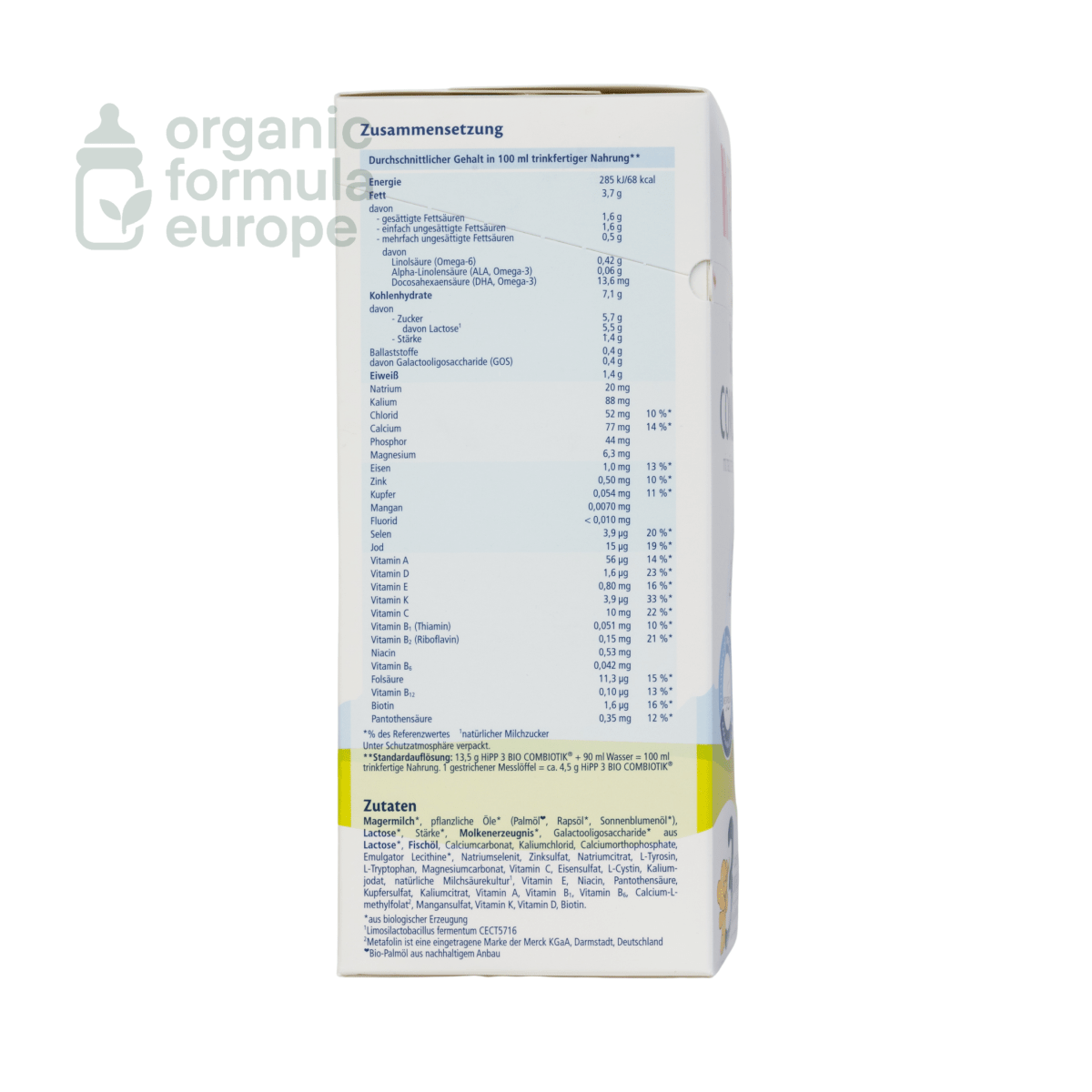

What you receive
The original European product, sealed at the factory
Every order ships as the exact product made for European store shelves. Nothing is relabeled or repacked, so the can or box you open is the one that left the factory.